









 Contacte con nosotros


In the high-stakes world of industrial laboratories and melt shops, the terms spectroscopy and spectrometry are often tossed around as if they are the same thing. While they are closely related, they aren’t identical.
For the engineers, metallurgists, and QC teams tasked with certifying high-value alloys, understanding this distinction is more than just a lesson in semantics. It’s about understanding the journey from a physical spark to a certified chemical composition report.
What Is Spectroscopy? (The “How”)
Think of spectroscopy as the scientific “theory” or the study of a phenomenon. It refers to the study of how matter—in our case, metal—interacts with electromagnetic radiation.
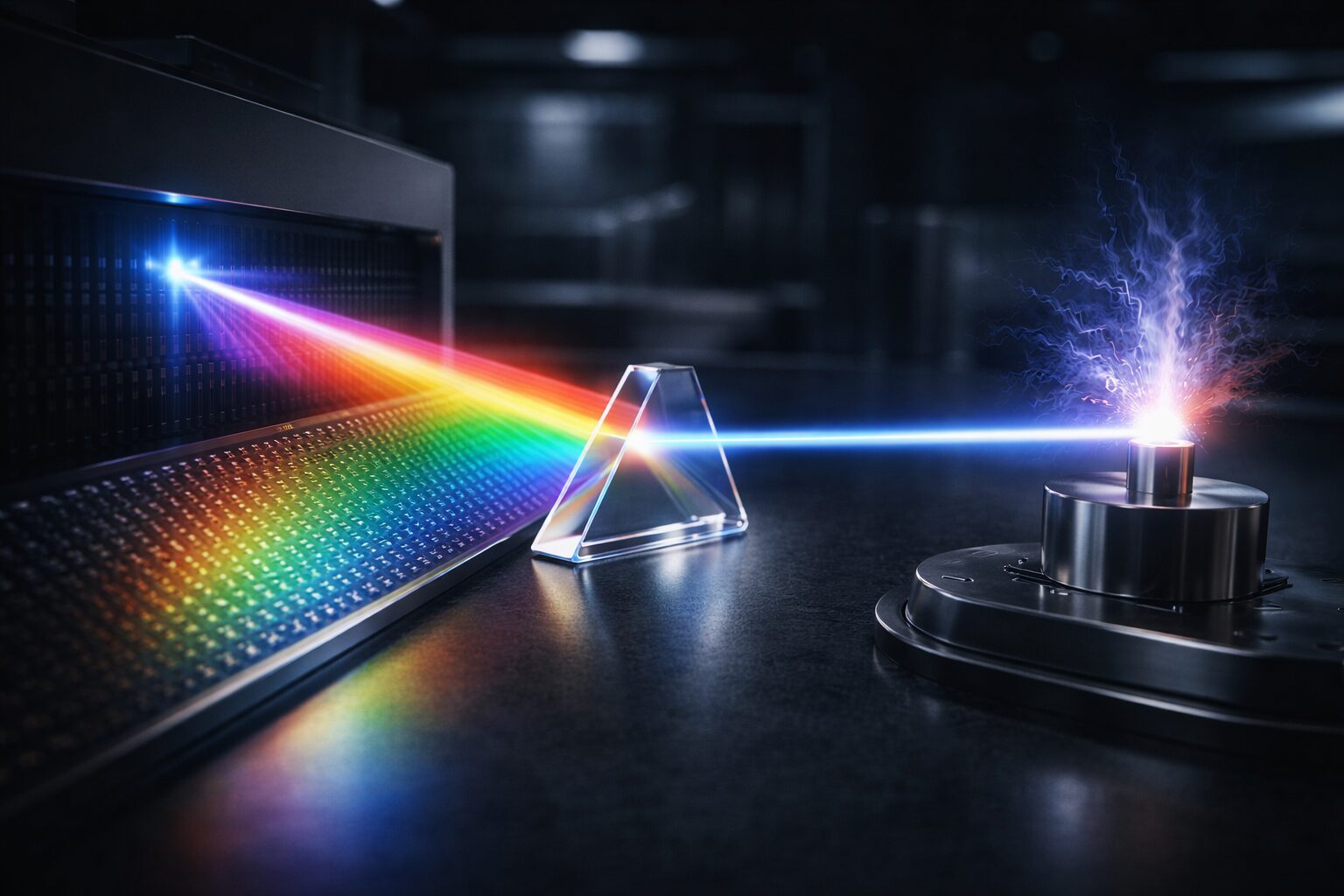
When you introduce energy to a metal sample, the atoms become “excited.” As they return to their ground state, they release energy in the form of light. Because the arrangement of electrons in every element is unique, each element emits light at specific, characteristic wavelengths.
In short, Spectroscopy is the study of how elements interact with light, describing the phenomenon that allows us to identify each element by its unique spectral signature.
What Is Spectrometry? (The “How Much”)
While spectroscopy is the science of the interaction, spectrometry is the practical application of measuring it. It is the quantitative foundation of materials analysis.
Spectrometry involves using specialised instruments to detect, separate, and quantify those spectral signals. If spectroscopy tells us which elements are present (the qualitative “what”), spectrometry tells us exactly how much is present (the quantitative “how much”).
In a metal testing environment, spectrometry measures:
- Wavelengths (to identify which element is present)
- Intensity (to determine the concentration of each element)
The Role of the Spectrometer in Metal Analysis
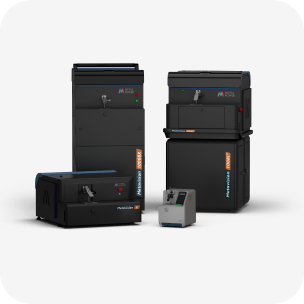
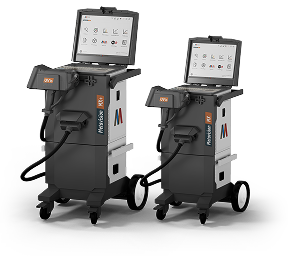
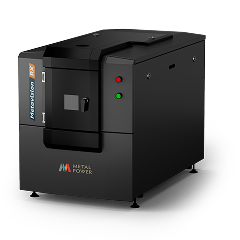
A spectrometer or an optical emission spectrometer is the scientific instrument (physical instrument) that bridges the gap between the scientific principle and the final report. In modern metal analysis, the spectrometer captures the light from an excited sample, isolates the individual wavelengths via a diffraction grating, and uses high-precision detectors to measure their intensity.
While spectroscopy defines how the atoms behave, spectrometry is the measurement framework that turns that behaviour into a number on a screen and thus delivers actionable insights for manufacturers and testing laboratories.
Why This Distinction Matters in the Industry
In a foundry or a steel plant, the difference between these two becomes very practical when evaluating analytical performance:
- Analytical Accuracy: The underlying spectroscopy determines which signals are available, but the design of the spectrometer determines how reliably those signals are captured.
- Detection Limits: While spectroscopic behaviour defines which elements can emit light, the spectrometer’s sensitivity determines the lowest concentration often at sub-parts-per-million levels it can actually “see.”
- Stability: Even if the spectroscopic principle remains constant, the quality of the spectrometer—its optical design and detector stability—determines whether your results remain consistent across multiple production shifts and varying ambient conditions.
Optical Emission Spectrometry (OES): The Gold Standard
In the world of metal manufacturing, Optical Emission Spectrometry (OES) is the most common application where these two concepts merge.
The spectroscopy part involves the emission of light from the metal sample through spark excitation. The spectrometry part involves measuring that light with high-resolution optical systems. This synergy allows for the simultaneous analysis of dozens of elements, from carbon and nitrogen to trace impurities in complex alloys.
This is why Optical Emission Spectrometry (OES) is the standard for a wide range of industrial applications:
-
Steel Production & Ladle Analysis:
OES is the only technology that allows for a “stop-go” decision at the furnace. By providing full chemical composition—including critical light elements like Carbon and Nitrogen—within seconds, it enables real-time melt corrections before the metal is tapped.
-
Precise Alloy Grading (L-Grade Verification):
In stainless steel production, the difference between a standard grade and a “Low Carbon” (L-Grade) variant is just a few hundred parts per million. OES provides the precision required to verify these tight tolerances, ensuring compliance with international standards like ASTM.
-
Foundry Melt Monitoring:
For cast iron and non-ferrous foundries, OES is used to monitor magnesium treatment in ductile iron and to control alloying elements like copper, silicon, and manganese in aluminium alloys — as well as titanium and zinc content in die-casting grades to ensure mechanical properties.
-
Trace Element & Impurity Detection:
OES is vital for identifying “tramp elements” or impurities (such as Lead, Tin, or Arsenic) that can enter the melt through scrap. Detecting these at sub-ppm levels is essential to prevent embrittlement or failure in the final product.
-
Incoming Material Inspection (PMI):
Manufacturers use OES for Positive Material Identification (PMI) to verify that the raw materials received from suppliers match the accompanying Material Test Certificates (MTC), preventing costly material mix-ups in the production line.
-
Recycling & Scrap Sorting:
High-end recycling centres rely on OES to instantly differentiate between visually identical but chemically distinct alloys, such as different series of aluminium or nickel-based superalloys, maximising the value of the recycled material.
-
Regulatory Compliance &Export Certification:
Because OES results are recognised by global standards (ISO, ASTM, DIN), it is the primary tool used to generate the official documentation required for export shipments and engineering, procurement, and construction (EPC) projects.
Summary Table: Spectroscopy vs. Spectrometry
Feature |
Spectroscopy |
Spectrometry |
| Focus | The scientific study of light/matter interaction. | The quantitative measurement of that interaction. |
| Output | Theoretical understanding of an element’s “spectral fingerprint.” | Numerical data (concentration percentages). |
| Function | Identifies the presence of each element. | Determines the concentration of each element |
| Industrial Use | The principle behind OES, XRF, and ICP. | The process used to generate a Material Test Certificate (MTC). |
Conclusion
At Metal Power Analytical, we believe that better analytical decisions start with clarity. Spectroscopy gives us the scientific foundation to “see,” i.e., understand what is happening at the atomic level in the metal, while spectrometry gives us the precision to “understand,” i.e. quantify it for industrial certification.
By combining advanced spectroscopic principles with high-performance spectrometric instrumentation, we ensure that your metal analysis is not just fast, but fundamentally accurate.
About Author


 On this page

